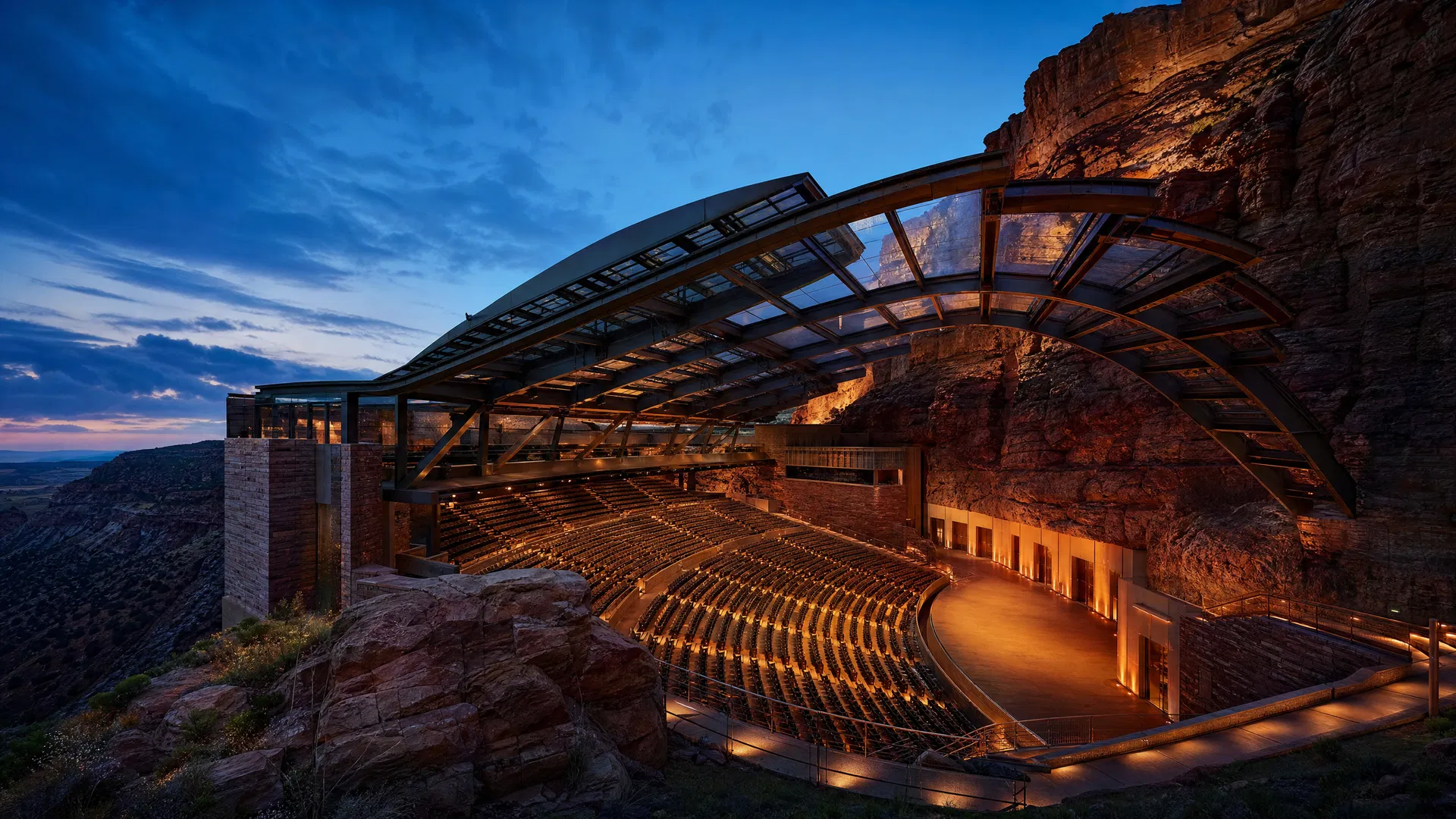
When the architects and engineers first walked the quarry site in Provo Canyon, they faced a fundamental question: how do you build something extraordinary in a place that has already been damaged — without damaging it further?
The answer became the design philosophy of Vesper Amphitheater. Every structural decision, from the shape-shifting retractable roof to the orientation of the seating bowl, was made with the canyon in mind. The mountain was not an obstacle to work around. It was the collaborator.
This is not a common approach in the concert venue industry. Most large-scale outdoor amphitheaters are built on flat, cleared land — the site is prepared to receive the structure, not the other way around. The structure arrives, the land is graded, the parking lots are poured, and the result is a venue that could exist anywhere. The landscape is incidental.
At Vesper, the landscape is the point.
Starting with What Was Already There
The quarry site presented a paradox. On one hand, it was damaged land — stripped of topsoil, compacted by decades of heavy equipment, and visually scarred in ways that would take years to fully heal. On the other hand, the quarry's excavation had created something that most amphitheater designers spend enormous effort and money trying to replicate: a natural bowl.
The blasted rock faces of the quarry walls form a natural acoustic reflector. The excavated depression creates a natural seating gradient. The canyon walls to the north and east provide wind protection and frame the stage with a backdrop that no set designer could improve upon. The quarry, in other words, had already done much of the work that amphitheater design normally requires.
The Vesper design team recognized this and built around it. Rather than filling the quarry depression and starting from a flat grade, the seating bowl follows the natural contours of the excavated site. Rather than building walls to create acoustic separation from the surrounding landscape, the existing rock faces serve that function. The structure works with what is there — amplifying the natural geometry of the site rather than overriding it.
"We kept asking ourselves: what does this place want to be? The answer was always the same. It wants to be a place where people gather to listen — to music, to the canyon, to each other." — Vesper Design Philosophy
The Shape-Shifting Roof
The most distinctive architectural feature of Vesper is its retractable roof system — a kinetic structure that can transform the venue from a fully enclosed indoor hall to a completely open-air amphitheater in a matter of minutes.
This is not a novelty feature. It is a direct response to the realities of performing in a mountain canyon environment.
Utah weather is notoriously variable. A summer evening in Provo Canyon can begin with clear skies and end with a thunderstorm rolling in from the Uintas. A spring concert can be warm at 6 p.m. and cold enough to require a jacket by 9. The retractable roof allows Vesper to respond to these conditions in real time — opening to the stars when the weather cooperates, closing to protect both performers and audience when it does not.
The acoustic implications are equally significant. When the roof is open, the canyon walls and the natural topography of the site shape the sound. When the roof is closed, the interior geometry of the structure takes over, creating a listening environment comparable to a purpose-built indoor hall. The result is a venue that can deliver exceptional acoustic performance in both configurations — something that no fixed-roof outdoor amphitheater can claim.
The roof structure itself was designed to minimize visual impact when viewed from the canyon road below. From a distance, the venue is intended to read as part of the landscape — a structure that has grown from the rock rather than been imposed upon it. The materials palette reflects this intention: natural stone, weathered steel, and timber that will age and patinate to match the surrounding geology.
Acoustic Design in a Canyon Setting
The acoustic challenge of an outdoor amphitheater is fundamentally different from that of an indoor concert hall. In an enclosed space, sound reflects off walls and ceiling, building reverb and warmth. In an open space, sound escapes into the air, losing energy and definition with distance.
The quarry site at Vesper partially solves this problem through its natural geometry. The rock walls that surround the seating bowl reflect sound back toward the audience in ways that a flat, open site cannot. But the Vesper acoustic design team went further, working with the canyon's natural characteristics to create what they describe as a "layered acoustic environment."
The primary sound system delivers direct sound to every seat in the house with consistent coverage and minimal delay. The canyon walls provide secondary reflections that add warmth and spatial dimension. The retractable roof, when closed, adds a tertiary layer of reflections that brings the acoustic character of the space closer to an indoor hall. The result is a listening experience that changes subtly depending on the configuration — open-air for summer concerts, enclosed for autumn and spring performances — but maintains exceptional clarity and impact in all conditions.
Minimizing the Footprint
Every square foot of the Vesper site that is not occupied by the venue structure, parking, or essential infrastructure is being restored to native habitat. This is not a generous gesture — it is a design constraint that shaped every decision about the venue's footprint.
The parking strategy reflects this constraint directly. Rather than building surface parking lots that would consume restored land and generate stormwater runoff, Vesper's transportation plan prioritizes shuttle service from remote parking areas, bicycle access via the Provo River Trail, and pedestrian connections from nearby neighborhoods. The goal is to minimize the number of cars that arrive at the site on event days — not just for environmental reasons, but because the experience of arriving at Vesper by trail or shuttle, through the restored landscape, is part of the experience itself.
The venue's energy systems are designed to the same standard. Solar panels integrated into the roof structure generate a portion of the venue's operational energy. LED lighting throughout the site reduces energy consumption and minimizes light pollution — a significant concern in a canyon environment where dark skies are part of the appeal.
What Other Venues Could Learn
The design philosophy of Vesper is not unique to this site. The principles that guided it — work with the natural geometry of the land, minimize the structural footprint, treat acoustic performance and environmental responsibility as complementary rather than competing goals — are applicable to any large-scale outdoor venue project.
The concert venue industry has been slow to adopt these principles. The dominant model remains the purpose-built amphitheater on a cleared, flat site, surrounded by surface parking and accessed primarily by private car. This model is efficient to build and operate. It is also increasingly out of step with the values of the audiences it serves.
Younger concert-goers, in particular, are paying attention to the environmental practices of the venues they patronize. The market is moving toward sustainability. Vesper is simply ahead of it.
A Structure That Will Age Well
The final test of any building is not how it looks when it opens, but how it looks in twenty years. The materials and systems chosen for Vesper were selected with this in mind.
The natural stone and weathered steel of the exterior will age gracefully, developing a patina that integrates the structure more deeply into its canyon setting over time. The native plantings around the venue will mature and thicken, softening the boundary between built and natural environments. The trails will be worn smooth by thousands of feet, acquiring the character that only use can create.
In twenty years, Vesper should look like it has always been there. That is the highest compliment you can pay to a building in a landscape as beautiful as Provo Canyon.
Read more: From Industrial Scar to Living Landscape · Acoustic Perfection Under Open Sky · The Vesper Promise